


A merger of similars would put $13.1 billion in assets and nearly 836,000 members under one federal charter. This is what the public record shows.
Michigan State University Federal Credit Union (MSUFCU) of East Lansing, Michigan, and University Federal Credit Union (UFCU) of Austin, Texas, said in a joint press release on October 13 that they plan to combine. According to a definitive agreement signed by both credit unions' boards, MSUFCU's charter would survive the combination, with the merged institution operating as University Federal Credit Union. Each brand would stay in its home market.
MSUFCU's president and CEO, April Clobes, is expected to become CEO. UFCU's president and CEO, Michael Crowl, would become president. The credit unions expect to close in summer 2027, subject to approval by the National Credit Union Administration (NCUA) and a vote by UFCU's members. Their nearest branches, in Chicago and Houston, are 942 miles apart.
CUCollaborate classifies a combination by the smaller party's assets as a share of the larger party's. UFCU's $4.27 billion in assets is 48% of MSUFCU's $8.87 billion, which places this deal in the band CUCollaborate calls a merger of similars. Deals at 70% or above are classed as mergers of equals, and those under 30% as absorptions. The bands are CUCollaborate's own, not an industry standard. In CUCollaborate's experience, governance in the middle band is usually negotiated rather than inherited.
Deal snapshot
Figure 1: MSUFCU and UFCU at a glance, June 30, 2026 unless noted
| MSUFCU | UFCU | |
|---|---|---|
| Scale | ||
| Headquarters | East Lansing, MI | Austin, TX |
| Charter | Federal, multiple common bond (primarily educational), charter 23279, founded 1937Federal, multiple common bond, charter 23279, founded 1937 | Federal, multiple common bond (primarily educational), charter 1367, founded 1936Federal, multiple common bond, charter 1367, founded 1936 |
| Total assets, June 30, 2026 | $8,868,387,451$8.87B | $4,269,250,552$4.27B |
| Total assets, Dec. 31, 2025 | $8,376,039,088$8.38B | $4,198,948,014$4.20B |
| Members | 405,979 | 429,865 |
| Branches / employees | 38 / 1,427 | 30 / 749 |
| Capital | ||
| Equity and ratio, including unrealized losses | $702,995,920 / 7.93%$703.0M / 7.93% | $393,664,633 / 9.22%$393.7M / 9.22% |
| Equity ratio excluding unrealized losses | 8.06% | 9.53% |
| Net worth ratio, Dec. 31, 2025 | 8.43% | 9.38% |
| Earnings | ||
| Net income, FY2025 / return on assets (ROA) | $25,619,649 / 0.31%$25.6M / 0.31% | $19,546,242 / 0.48%$19.5M / 0.48% |
| Net income, FY2024 | ($21,309,406)($21.3M) | $26,649,733$26.6M |
| Net income, H1 2026 / annualized ROA | $13,565,594 / 0.31%$13.6M / 0.31% | $16,348,159 / 0.77%$16.3M / 0.77% |
| Operating expense / average assets, H1 2026 annualized | 3.70% | 4.58% |
| Funding | ||
| Loans / shares / loan-to-share | $6,924,688,230 / $7,276,711,388 / 95.16%$6.92B / $7.28B / 95.16% | $2,968,261,592 / $3,462,800,178 / 85.72%$2.97B / $3.46B / 85.72% |
| Borrowings, share of assets | $708,000,000 (7.98%), plus $74,144,798 subordinated debt$708.0M (7.98%), plus $74.1M sub debt | $300,840,670 (7.05%)$300.8M (7.05%) |
| Cost of funds, annualized, on shares plus borrowings | 2.06% | 1.12% |
| Credit | ||
| Provision for credit losses, H1 2026 / allowance to loans | $40,445,042 / 1.40%$40.4M / 1.40% | $21,646,403 / 1.79%$21.6M / 1.79% |
Source: NCUA Form 5300 call reports, June 30, 2026 and December 31, 2025 cycles; UFCU's 2025 Annual Report; MSUFCU's Consolidated Statement of Financial Condition. Charter details from NCUA Credit Union Details.
Annualized ratios double the six-month figure. Average assets are the mean of the December 31, 2025, and June 30, 2026, totals. Equity ratios use June 30, 2026 total assets. Figures are abbreviated on small screens.
Deal terms. MSUFCU's charter continues under the name University Federal Credit Union. The MSUFCU brand stays in Michigan and Illinois, and the UFCU brand stays in Texas. Because this is a merger between two credit unions, there is no purchase price.
Timeline. The definitive agreement is signed. NCUA approval and a UFCU member vote are still required. The legal closing date, called Legal Day One, is expected in summer 2027. Integration planning begins after approvals.
The press release puts the combined institution at "more than 850,000 members" and "$13.5 billion in assets."1 June 30 call reports show 835,844 members and $13.14 billion.2 MSUFCU's own announcement to members cites "over $9.3 billion" in assets, against $8.87 billion on its call report. This article uses call report figures.
The cost-savings limit
The usual argument for scale is that the acquirer runs the combined balance sheet at its own lower cost and passes the savings to members. MSUFCU's operating expenses run at 3.70% of average assets and UFCU's at 4.58%. Bringing UFCU's $4.23 billion in average assets down to MSUFCU's rate would save about $37.0 million a year, or $86 per UFCU member. On this method, that is the most UFCU's members could expect from cost savings. It equals 88% of what UFCU pays each year in dividends and borrowing costs, and 19% of its annual loan interest income.
Two caveats apply. Some of UFCU's higher spending supports revenue that MSUFCU's ratio does not reflect. In 2025, UFCU booked $96.5 million in non-interest income and managed $738 million through its investment services business. And because the two markets do not overlap, any savings would have to come from combining back-office operations, technology, and vendors. A Filene Research Institute study of credit union mergers from 1984 to 2009, by James Wilcox and Luis Dopico, found that savings of this kind came more slowly and less reliably.3
Who contributes what, and who gets what
Figure 2: Share of the combined institution
| Share of the combined institution | MSUFCU | UFCU |
|---|---|---|
| Total assets67.5% / 32.5% | 67.5% | 32.5% |
| Members48.6% / 51.4% | 48.6% | 51.4% |
| Loans70.0% / 30.0% | 70.0% | 30.0% |
| Equity64.1% / 35.9% | 64.1% | 35.9% |
| Net income, FY202556.7% / 43.3% | 56.7% | 43.3% |
| Net income, H1 202645.3% / 54.7% | 45.3% | 54.7% |
| Branches55.9% / 44.1% | 55.9% | 44.1% |
| Employees65.6% / 34.4% | 65.6% | 34.4% |
Source: NCUA Form 5300 call reports, June 30, 2026 cycle; UFCU's 2025 Annual Report; MSUFCU's Consolidated Statement of Financial Condition.
Elements of the deal
Surviving charter. MSUFCU's federal charter continues.4
Member vote. UFCU's 429,865 members will vote. MSUFCU's 405,979 members will not.
Name. The corporate name will be University Federal Credit Union. The UFCU brand continues in Texas, and the MSUFCU brand continues in Michigan and Illinois. Accounts and cards keep their current branding.
Headquarters. Not stated in the press release or either member FAQ. It will appear in the NCUA merger application and the member notice.
CEO. April Clobes has been MSUFCU's president and CEO since 2015. She joined the credit union in 1996 as a marketing specialist. She has also led Reseda Group, MSUFCU's wholly owned credit union service organization (CUSO), since 2021.
President. Michael Crowl is UFCU's president and CEO. He joined UFCU in 2005 and was named president in August 2021. He became co-CEO in October 2022 and sole CEO when Tony Budet retired in March 2023. Crowl is a certified public accountant and was the Austin Business Journal's 2018 nonprofit "Best CFO."
Board seat split. Not yet disclosed. The member notice required by NCUA's merger rule, 12 CFR 708b, will show the continuing board's makeup.5
Executive team. Not disclosed beyond the CEO and president.
Employees. Both FAQs state that every employee will have a position in the combined organization and that branch staff stay in place.
Branches. Both FAQs state that local branches remain open with the same employees.
Systems and conversion. Not stated. The FAQs say integration planning starts after regulatory approval.
Compensation on record. The member notice has not yet been filed. Once filed, it must disclose any merger-related pay or benefit increase for senior officials or directors above the greater of $10,000 or 15%, if applicable.
What the credit unions say the deal is for, and what the balance sheets say
Each credit union has posted a member FAQ page on the deal. Both say a larger, more geographically diverse institution would compete better with national banks and fintechs. They describe combining UFCU's digital modernization with MSUFCU's innovation program and CUSO platform. They also cite a wider product range, stronger capital, and more campus funding. Local broadcaster WILX and Credit Union Times quoted Clobes as saying that she and Crowl believed value mattered more than size.
The balance sheets show differences in funding. MSUFCU has lent out 95% of its shares and carries $708 million in borrowings plus $74 million in subordinated debt. Share drafts make up about a fifth of its shares, and it pays 2.06% for funds. UFCU has lent out 86% of its shares, holds 36% of them in share drafts, and pays 1.12%. The merger would combine UFCU's lower-cost, less fully lent deposit base with MSUFCU's loan demand.
Earnings differ too. MSUFCU returned to profit in 2025, earning $25.6 million after a $21.3 million loss the year before. Its annualized return on assets for the first half of 2026 was 0.31%. UFCU earned $19.5 million in 2025, down from $26.6 million in 2024, and its first-half return annualizes to 0.77%. UFCU's provision for credit losses rose to $46.0 million in 2025 from $33.0 million the year before. Its allowance covers 1.79% of loans, against 1.40% at MSUFCU. Both remain above 7% equity to assets on every measure.
Competition: no overlapping markets
The two credit unions do not compete anywhere. MSUFCU's 38 branches are in Michigan and Illinois, and UFCU's 30 are in Central Texas and the Houston area. No county's deposit shares change, and no competitive review applies. The lack of overlap also rules out savings from closing branches, so the full $37.0 million limit would depend on merging core systems, digital platforms, and vendor contracts.
Charter and field of membership
Figure 3: Two footprints, 942 miles apart at their closest point
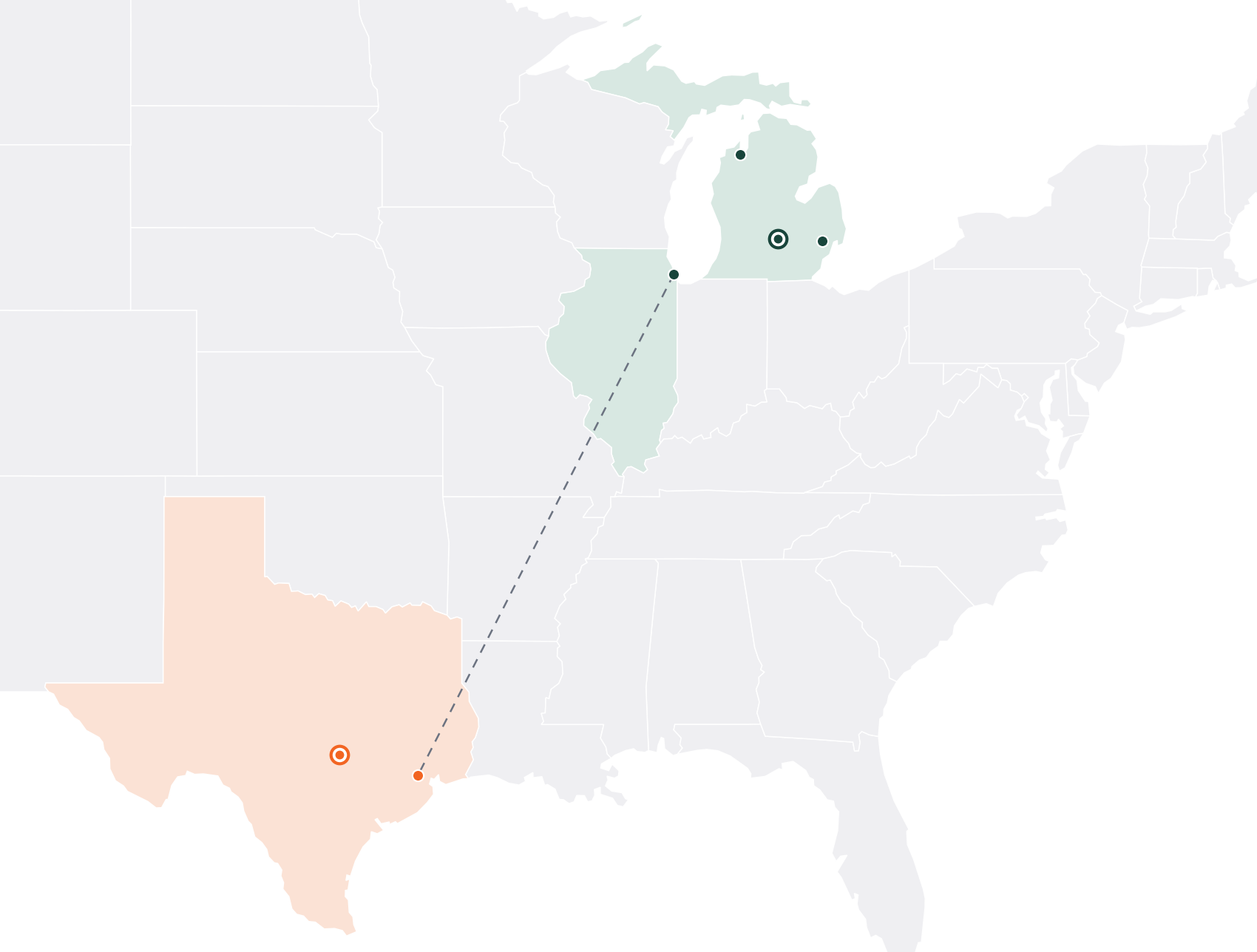 Traverse City
East Lansing (HQ) 9
Detroit metro
Northern Illinois 9
nearest branches: Chicago to Houston, 942 mi
Austin (HQ) 16
Houston area
Traverse City
East Lansing (HQ) 9
Detroit metro
Northern Illinois 9
nearest branches: Chicago to Houston, 942 mi
Austin (HQ) 16
Houston area
- MSUFCU branch (38)
- UFCU branch (30)
- Headquarters
- States with MSUFCU branches (MI, IL)
- State with UFCU branches (TX)
Branches plotted at city center from NCUA Form 5300 branch records, June 30, 2026 cycle; state boundaries from U.S. Census Bureau cartographic boundary files. Numbers are branches in that cluster. Shaded states show where branches are, not where membership eligibility ends.
Both hold federal multiple common bond charters built mainly on educational groups. MSUFCU serves the Michigan State and Oakland University communities, along with employer and association groups in Michigan and Illinois. UFCU says it serves "more than 250 universities, colleges, associations, and employers across Texas." Because MSUFCU's charter is expected to survive, UFCU's groups will move into its field of membership without a separate charter action. UFCU members will join the continuing charter on Legal Day One with their accounts unchanged.
The result would be one federal charter with branches in three states and headquarters 1,131 miles apart. It would serve university communities that have no apparent tie to each other beyond the merger. The Federal Credit Union Act allows this, because multiple common bond charters are not limited by geography.
Convenience, needs, and community
Both networks are built around campuses and their suburbs. Sixteen of UFCU's 30 branches are in Austin, including an office at Gregory Gym (a University of Texas at Austin athletics facility). UFCU opened three more in 2025, including one at the Texas Medical Center. MSUFCU has nine offices in East Lansing and the Lansing area and nine in Illinois, which came through recent bank acquisitions. Both FAQs say branches will stay open and every employee will keep a job.
The implied member
The balance sheets suggest two different kinds of household. The average MSUFCU member holds $17,924 in shares and $17,057 in loans, and real estate secures 53.3% of the credit union's loan book. The average UFCU member holds $8,056 in shares and $6,905 in loans, with auto loans making up much of its loan book. Last year UFCU made 19,086 auto loans and 1,190 home loans while adding more than 43,000 members.
Employee sentiment
Glassdoor ratings differ between the two employers.6 Glassdoor reviews are posted voluntarily and are not a representative sample of staff. MSUFCU is rated 2.7 out of 5 on 247 reviews, with 27% of reviewers recommending it as an employer and 36% approving of Clobes. Its lowest score, 2.4, is for career opportunities. UFCU is rated 3.4 on 201 reviews, with 54% recommending it and 49% approving of Crowl. MSUFCU has appeared on the Detroit Free Press Top Workplaces list for 13 straight years as of 2024.
Academic research treats employee sentiment as a factor in mergers. One study found that employee morale predicts how merger partners are chosen and how integration goes. Another found that staff satisfaction at the acquirer tends to fall after a deal, and that the drop predicts weaker performance. A third linked cultural distance, measured on Glassdoor, to smaller gains from combining.7
Neither credit union has said how it plans to bring the two workforces together. The FAQs place integration planning after regulatory approval.
Member voice
With the deal a day old, no member reaction is on record. However, the voting structure is already set. UFCU's 429,865 members will receive a notice under NCUA's merger rule, 12 CFR 708b, and vote at a special meeting on a date yet to be set. MSUFCU's 405,979 members will not vote, because their charter continues. The notice will disclose the board's makeup and any merger-related pay arrangements, along with any member benefit the boards choose to quantify. Neither FAQ mentions changes to dividends, rates, or fees.
Regulatory path
Because both charters are federal, the deal needs approval only from NCUA and UFCU's members. No state regulator is involved.
What comes next
The next public document regarding the combination is the merger notice UFCU must send its members under 12 CFR 708b. In the notice, we can expect to find details regarding the continuing board, the headquarters, and any merger-related pay arrangements. It will also set the date of the member vote.
Neither credit union has published a dollar figure for what members would gain. Once the deal closes, the combined credit union's operating costs, rates, and branch count can be compared with the figures in this article.
How CUCollaborate can help
A 708b notice is where a member benefit figure would appear, and neither board has published one yet. Our Merger Member Benefit analysis quantifies, account by account, what a proposed combination does to the dividends, rates, and fees both memberships actually pay. If your board is weighing a merger or preparing its notice, book 30 minutes and we will work through your call report data with you.
Sources
- UFCU, "UFCU and MSU Federal Credit Union to Strategically Combine," October 13, 2026, ufcu.org. The same release as carried by CUInsight.
- NCUA Form 5300 call reports, June 30, 2026 and December 31, 2025 cycles, for Michigan State University Federal Credit Union (charter 23279) and University Federal Credit Union (charter 1367), including the branch records, via NCUA's Research a Credit Union and Credit Union and Corporate Call Report Data pages. Branch distances are measured between city centers.
- James A. Wilcox and Luis G. Dopico, "The Impact of Mergers on Credit Union Costs: 1984 to 2009," Filene Research Institute, 2011 (working paper PDF).
- Member pages and FAQs, "Building Dreams Together": MSUFCU and UFCU, both read October 14, 2026.
- 12 CFR Part 708b, NCUA's merger rule for federally insured credit unions, including the member-notice disclosure of merger-related financial arrangements (§ 708b.106).
- Glassdoor public company pages for Michigan State University Federal Credit Union and University Federal Credit Union, read October 14, 2026.
- Kristina Lalova-Yuhasz, "The Value of Employee Morale in Mergers and Acquisitions: Evidence from Glassdoor," SSRN 4390811. Douglas J. Fairhurst, Hongrui Feng, and Yuri Zhu, "Mergers, Employee Satisfaction, and Merger Outcomes: Evidence from Glassdoor Ratings," SSRN 4984561. Marius Brede, Hannes Gerstel, Arnt Wöhrmann, Andreas Bausch et al., "Mind the gap: the effect of cultural distance on mergers and acquisitions: evidence from Glassdoor reviews," Review of Managerial Science 19 (2025), published online October 2024.
Also consulted. NCUA Credit Union Details pages for charter 23279 and charter 1367, for charter and membership type. UFCU's 2025 Annual Report (PDF) and MSUFCU's Consolidated Statement of Financial Condition as of December 31, 2025 (PDF), for annual figures. UFCU's announcement of Michael Crowl and Finopotamus on April Clobes, for the executive biographies. WILX and Credit Union Times, for the Clobes quotation. MSUFCU's bank acquisition notices for Algonquin State Bank, McHenry Savings Bank, and Gold Coast Bank, for the Illinois branch history.
Data notes. The joint press release's "$13.5 billion" and MSUFCU's member announcement of "over $9.3 billion" do not match the June 30 call reports. Those show $13,137,638,003 combined and $8,868,387,451 for MSUFCU. The press release also cites "more than 800 employees" at UFCU, while its call report shows 749. Branch locations are plotted at city center.


